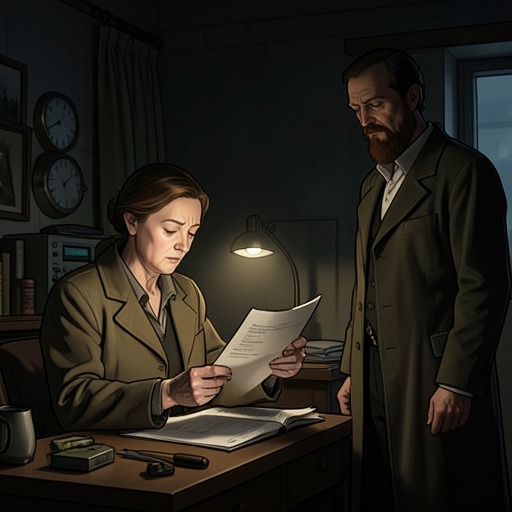
Avdotya Romanovna Raskolnikova
Crime and PunishmentAvdotya Romanovna Raskolnikova is Rodion Romanovitch Raskolnikov’s strong-willed sister, a provincial governess whose attempts to help her family make her vulnerable to both economic pressure and sexual harassment. Her story moves from a concealed financial sacrifice, through public slander and vindication, to a hurried engagement that her brother interprets as another sacrifice made for his sake. The tension between her stated resolve and the constrained choices around her makes her more than the object of her family’s concern: she is the person whose endurance, judgment, and moral independence are at stake.
Family Loyalty and Financial Sacrifice
When Avdotya took a governess’s position in the Svidrigailovs’ household, she received a hundred roubles in advance, with part of her salary to be withheld each month until the debt was repaid. She had accepted the advance chiefly so that she could send Rodion sixty roubles, money he urgently needed. The family had told him that it came from her savings; the truth was concealed from him until their mother explained it in her letter. Avdotya’s help thus involved not only surrendering part of her earnings but allowing her brother to misunderstand the cost of what he received.
The debt also narrowed her ability to leave her employment. When Mr. Svidrigailov’s conduct became intolerable, she could not simply walk away without repaying the advance. Her mother’s account gives a further reason for delay: Avdotya feared that an abrupt departure would arouse Marfa Petrovna’s suspicions and cause a rupture in the household. The circumstances kept her there for another six weeks. Her endurance was not an abstract virtue, but a response to financial obligation, concern for others, and the risk that leaving would create further harm.
Avdotya also withheld the full account from her mother, although they were in constant communication, because she feared upsetting her. Her mother presents her as able to bear a great deal and to maintain her firmness under strain. That description is admiring, but it also identifies the burden placed on Avdotya: family members understand her capacity to endure as a reason she can be asked, or expected, to endure more.
Harassment, Accusation, and Public Vindication
According to her mother’s letter, Mr. Svidrigailov first treated Avdotya rudely, making jeering and disrespectful remarks. His manner concealed, or at least accompanied, a passion that eventually became an explicit and shameful proposal. He offered inducements and proposed leaving with her for another estate or abroad. The offer made her position especially precarious: she was financially bound to the household, while a sudden departure risked both scandal and the distress of Marfa Petrovna, the employer’s wife.
The crisis broke when Marfa Petrovna overheard her husband pleading with Avdotya in the garden but misunderstood what she had witnessed. She blamed Avdotya, struck her, refused to hear her explanation, and ordered her sent away at once. Avdotya was put into an open peasant’s cart with her belongings thrown in without being packed. In heavy rain, she made the seventeen-verst journey to town. The abrupt expulsion turned a private abuse of power into a public disgrace: the accusation, rather than the circumstances that produced it, initially shaped how the community treated her.
For a month, gossip isolated Avdotya and her mother. Acquaintances avoided them, people made contemptuous remarks, and shopmen and clerks were reportedly planning to smear the gate of their house with pitch. Their landlord began urging them to leave. Marfa Petrovna had spread her version of the affair among families in the town and surrounding district, giving social humiliation a material consequence as well as a reputational one. Avdotya bore this treatment better than her mother did, but the letter stresses the strain the public hostility placed on them both.
The reversal came when servants’ evidence clarified what had happened. They knew more about the household than Mr. Svidrigailov had supposed, and their testimony cleared Avdotya. Marfa Petrovna became convinced of her innocence. On Sunday she went to the Cathedral, prayed in tears, and then came to Avdotya and her mother to confess her error and ask forgiveness. She followed the apology with a public campaign of correction, visiting houses throughout the town to affirm Avdotya’s innocence and good conduct. She also circulated Avdotya’s handwritten letter to Mr. Svidrigailov, allowing people to read and copy it. The effort restored Avdotya’s reputation, while the disgrace of the affair came to rest on her husband as the person responsible. Several families then offered Avdotya teaching work, though she refused it.
Engagement and the Terms of Respectability
After Avdotya’s reputation had been restored, she received a marriage proposal from Pyotr Petrovitch Luzhin, a forty-five-year-old government official with two posts and a fortune. Marfa Petrovna helped bring about the match. Pyotr Petrovitch sought an early answer because he was in a hurry to travel to Petersburg, and Avdotya consented after the proposal had been considered by the family. Her mother’s letter acknowledges that the arrangement was made quickly and without waiting for Rodion’s approval.
The match was presented as materially prudent, not as a love affair. Avdotya’s mother describes Pyotr Petrovitch as dependable and respectable, while also noting that he seemed somewhat morose and conceited. He called himself practical and said he shared some convictions of the rising generation. At a later visit, after Avdotya had consented, he explained that he had wanted to marry a woman of good reputation, without a dowry, and accustomed to poverty. He believed a husband should not be indebted to his wife; instead, he considered it preferable that a wife regard her husband as her benefactor. His remark, which he attempted to soften after making it, reveals the unequal terms on which he imagines marriage: the woman’s dependence is part of the arrangement’s appeal.
Avdotya’s mother says there is no great love on either side, but believes her daughter intends to make the marriage honourable and straightforward and to make her husband happy. She describes Avdotya as resolute, sensible, patient, generous, and passionate. Avdotya herself, as reported by her mother, says she can manage the anticipated differences in character and opinion. These assurances do not erase the unease surrounding the match. The proposed security comes with a structure in which Pyotr Petrovitch expects to be seen as benefactor, while Avdotya is expected to adapt and endure.
Rodion’s Interpretation of Her Choice
Rodion reacts to the engagement through the hidden sacrifice behind it. He recalls how much Avdotya had already endured in Mr. Svidrigailov’s household and refuses to believe that her capacity for endurance means she can accept any burden without cost. In his view, she would not surrender her moral freedom for comfort or money; if she has agreed to the marriage, it must be for someone else. He concludes that she and their mother are sacrificing her independence for his sake, hoping to secure his education, future work, and prosperity.
That interpretation is emotionally forceful, but it is Rodion’s judgment rather than a fully disclosed account of Avdotya’s motives. He understands the engagement as a transaction in which his future is bought with her freedom, and he likens the cost of its respectability to Sofya Semyonovna Marmeladova’s desperate response to poverty. The comparison exposes a common pressure while also preserving a difference: the women’s circumstances and the forms of sacrifice are not identical. Rodion fears that Avdotya may later find herself trapped in a marriage without love or respect, required to maintain appearances while concealing bitterness from her family.
His response sharpens the question raised by the engagement. Avdotya’s earlier help to Rodion was an act of family loyalty made under severe financial constraints; Rodion now suspects that the same loyalty is directing her toward a life with a man she does not love. The distinction between a choice made freely and a choice shaped by need remains unresolved in the available account. Her own judgment is reported only in fragments, while her mother’s hopes and Rodion’s alarm compete to explain what her consent means.
Narrative Role and Significance
Avdotya’s plot links private character to social and economic power. As a governess, she depends on an employer who can control her wages and place; as a woman accused of sexual impropriety, she faces a community ready to turn gossip into exclusion and threats to her family’s housing. Her vindication depends partly on witnesses from the household and on Marfa Petrovna using her social reach to reverse the story she had spread. Reputation is therefore shown not as a stable reflection of conduct but as something that can be damaged, circulated, and publicly repaired.
Her story also complicates the family’s idealization of endurance. Her mother praises her firmness; Rodion insists that it cannot justify asking her to suffer for him. Between these views, Avdotya’s consent to Pyotr Petrovitch’s proposal remains both an exercise of judgment and a decision made amid poverty, obligation, and family attachment. The evidence establishes her engagement and the pressures surrounding it, but not its eventual outcome. What it makes clear is the cost of treating a woman’s capacity to bear hardship as proof that hardship is acceptable.